Asexual people open up about the journey to self-acceptance and maintaining emotionally intimate relationships as Charlotte Colley speaks to them, dating app teams and relationship therapists about the often-misunderstood orientation.
Sanjana Acharya*, 23, realised she was asexual after feeling disconnected during her first sexual encounter when she was 16.
“When I first had sex, I didn’t enjoy it and felt that it wasn’t right. It wasn’t connecting, just unappealing. I felt pressured to enjoy it because my partner at the time did and worried they would look elsewhere if I wasn’t giving them what’s socially considered a ‘basic necessity of a relationship,” she says.
After experiencing the difficult relationship, she believed her sexual orientation would prevent her from finding an emotionally healthy and accepting partner.
“In that relationship, I felt obliged and therefore just awful and like I’m broken. I couldn’t understand why I wasn’t enjoying it. There’s still an element of that broken feeling,” she explains.
According to LGBT Health, asexuality is a sexual orientation in which individuals feel little or no sexual attraction, but many may still feel and develop romantic connections.
Often described as a spectrum, asexuality includes identities such as gray-romantics, those who don’t ever experience romantic attraction and demiromantics who only feel romantic attraction after a close emotional bond has been formed.
Confidence in her identity was another challenge Sanjana faced, unsure whether she was asexual or if “there was just something wrong with her.”
Shan Merchant, a couple’s therapist and affair recovery specialist, expresses the importance of distinguishing between being asexual or having a low libido in order to either treat the cause or accept yourself.
“Asexuality is not considered a dysfunction, it doesn’t mean a person cannot love, form deep attachments, or long for closeness. It’s different from low libido where factors like stress, hormonal changes, trauma, medication and others can influence our experience of desire,” she says.
“With asexuality, there typically isn’t that narrative of loss. It’s less about something diminishing and more about how someone has always experienced attraction.”
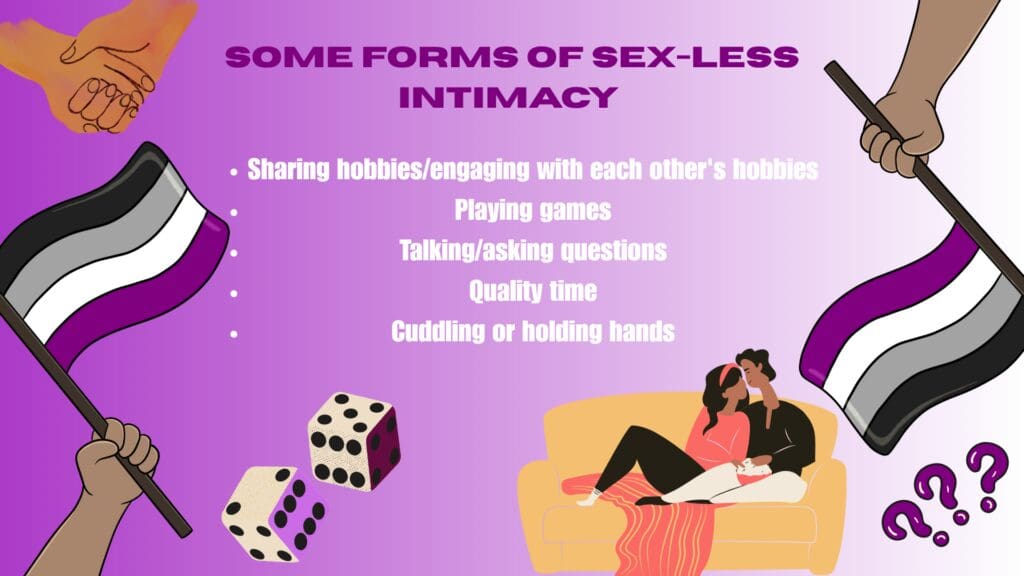
With 16 years experience the Yorkshire-based therapist also mentions that quality time is valuable for maintaining closeness in an ‘a-spec’ relationship.
Three years after that first relationship, Sanjana and her current partner, who met through mutual friends, spend quality time together by going to museums, watching movies, playing murder mystery games, and even having their own book club. All of which has helped change her perception of relationships.
“Before my current partner, I kind of accepted the idea that most relationships may require physical intimacy, especially as my first partner ended up cheating, but even when we tried to have sex once and I couldn’t, I felt awful and used and it just felt objectifying to me,” she says.
“I explained I don’t feel that sort of connection, which he understood after a series of conversations and me explaining it’s nothing to do with him. I’d just rather him want to know me for my interests and spend time with me. We’re long distance now but when we are together, we indulge in each other’s hobbies, which builds on our bond and focuses on emotional attunement and continuity.”
Quality time, though, is beneficial for all types of partnerships. The 2012 ‘Date Night Opportunity’ study found that couples who devote time to each other at least once a week were more likely to report high-quality relationships and lower divorce rates than those who didn’t.
However, for asexual relationships, Shan explains that quality time may be more vital to building connection as non-sexual intimacy can be shared through things like vulnerability, humour, rituals, companionship and non-sexualised physical closeness.
“Intimacy without sex can be deeply meaningful. It might simply be feeling safe in each other’s presence. In asexual relationships, couples often redefine what connection means,” she explains.
“The important thing is that whatever intimacy is chosen works when neither partner feels deprived or coerced and when the absence of sex isn’t a silent loss but a conscious agreement.”
Open communication also plays an integral role in maintaining closeness without physical intimacy.
For Ellis Martin*, 29, they started to identify as a teenager with asexuality after feeling their experiences of attraction and relationships were different and learning about the orientation in Tumblr communities.
With their partner, communication is a key factor in strengthening their relationship alongside lots of laughter, as Ellis explains.
“Emotional intimacy is about honesty and connection through conversation. I feel connected to someone when I know I can share anything I’m thinking or feeling, no matter how scary or uncomfortable, because we have space in the relationship for that,” they say.
“Navigating relationships as an ace person is often discussed in terms of physicality, but the bulk of it is more about communication. It’s about approaching things with an open mind and trusting that the other person will do the same.”
Dating apps such as Asexual Cupid, an online dating platform, are designed to focus on communication.
Launched in 2015 and with over 100,000 members, the purpose was to create a space for individuals seeking platonic relationships, love, and companionship without the sexual expectations.
“In asexual partnerships, intimacy is often uncoupled from sexuality and redefined on the individual’s own terms. This makes communication absolutely critical. Because there’s no assumed sexual script, couples must explicitly discuss their needs and boundaries.
This level of communication can build a very strong foundation of trust and understanding,” says Andy W, the current supervisor of Asexual Cupid, who didn’t want to give his last name due to company restructuring.
“Because the relationship is built on a foundation of deliberate choice rather than sexual attraction, it can foster a deep, intentional emotional intimacy. Partners may feel their bond is uniquely strong because it’s centred on shared values, emotional support, and companionship and requires ongoing, honest communication.”
However, asexuality can involve challenges and societal pressures that may personally impact them and their relationships.
Andy adds that in mixed-orientation partnerships, societal expectations to have a ‘normal’ sexual relationship can cause stress and feelings of rejection or undesirability.
In Ellis’s experience, when they first came out as demisexual, they experienced misconceptions that assumed sexual and romantic attraction were the same thing.
Recently, they’ve noticed a growing assumption that asexual people therefore must not want children, marriage or other relationship milestones.
“When things like this are generalised to the entire community, it can be alienating if they are things you want in your life. Sometimes, people don’t want to think deeply about sexuality, identity, or relationships in the way the ace community does, which forms a barrier of its own. A lack of curiosity or open-mindedness to new concepts inevitably results in misunderstandings that are difficult to correct,” they say.
This is why relationship therapists, like Shan, emphasise the importance of social and individual partner understanding to help with a person’s self-acceptance.
“Comments such as ‘you just haven’t met the right person yet’ can invalidate their reality. They may feel uncertain about how to share their sexual orientation without it being interpreted as a rejection. The pressure is more about belonging and whether one’s way of experiencing attraction is recognised and respected,” she says.
“I feel so loved and accepted by my friends and myself now that I don’t feel as broken anymore. I promised myself I wouldn’t ever accept a romantic relationship that would make me feel any different.”
sanjana Acharya
Neurodivergence can also play a role in the asexual identity, as a 2021 study by the University of Cambridge found that autistic adults and adolescents are eight times more likely to identify as asexual than non-autistic individuals.
For Sanjana, who was diagnosed with autism at five, she explains that her experiences of physical intimacy, navigating relationships and her asexual identity were shaped by it.
“Looking back, I always pretended to be this ideal partner when it was shrinking who I was, and I was in my previous relationship for four years. By the end of it, I lost my sense of self because I didn’t stand by who I knew I was,” she explains.
“It took a while to rebuild myself and come to terms with my asexuality and neurodivergence. There are adjustments that I do need, rather than trying to pretend that I function the same as others”.
Like many other autistic people, she can become overwhelmed with prolonged periods of physical touch, heightened sound levels and busy environments that all influence how she approaches intimacy.
“There are times when I just don’t want to be touched, as I can get overstimulated very easily and even when physical touch was okay, I still didn’t feel the want to have sex. My partner is neurotypical, and at first, he thought I didn’t like him. But when I explained it to him, he just accepted it as part of who I am,” she says.
Experts, such as Shan, also emphasise that maintaining boundaries as an asexual or neurodiverse asexual person is important to avoid self-betrayal or discontent building in the relationship.
A 2020 study, published in the Frontiers of Psychology, found that autistic adults in fact reported a lower sense of power in relationships and poorer overall self-esteem than neurotypical individuals, things that may lead to compromised self-boundaries.
“What I see far too often in any asexual person is self-abandonment, where one partner starts having sex out of duty, to keep the peace, or to avoid losing the relationship. The other may start shrinking their desire so they don’t feel demanding or too much,” Shan says.
“Suppressing erotic needs out of loyalty tends to lead to resentment. Equally, pressuring someone into sex to preserve the relationship erodes trust and safety. Neither strategy builds long-term closeness.”
Despite Sanjana finding a romantic connection, it was her friends and personal development that led to her accepting her asexual identity.
“As an asexual, there are so many more pleasures you can get from other things, like fulfilling your own passions, hobbies and finding love in everything around you first. As you grow older, the world is more than just sexual validation. Plus, you don’t have to have it all figured out, asexuality is fluid, and it’s always okay to develop and change your mind,” she says.
“I feel so loved and accepted by my friends and myself now that I don’t feel as broken anymore. I promised myself I wouldn’t ever accept a romantic relationship that would make me feel any different.”
*Names have been changed for anonymity purposes