

A survey of 2,000 UK adults has found that the majority have never been screened for four of the most common sexually transmitted infections.
Superdrug’s Great British Sex Report 2026 noted 57% of respondents had never been tested for HPV, 56% for gonorrhoea, and 55% each for chlamydia and HIV – all infections routinely offered through the NHS and sexual health clinics.
“Many STIs don’t cause obvious symptoms, which means people often assume they’re fine and skip testing.
“These infections can go unnoticed for months or years, potentially causing long-term health issues and being passed on without anyone realising,” Dr Babak Ashrafi, the clinical lead, added in the report.
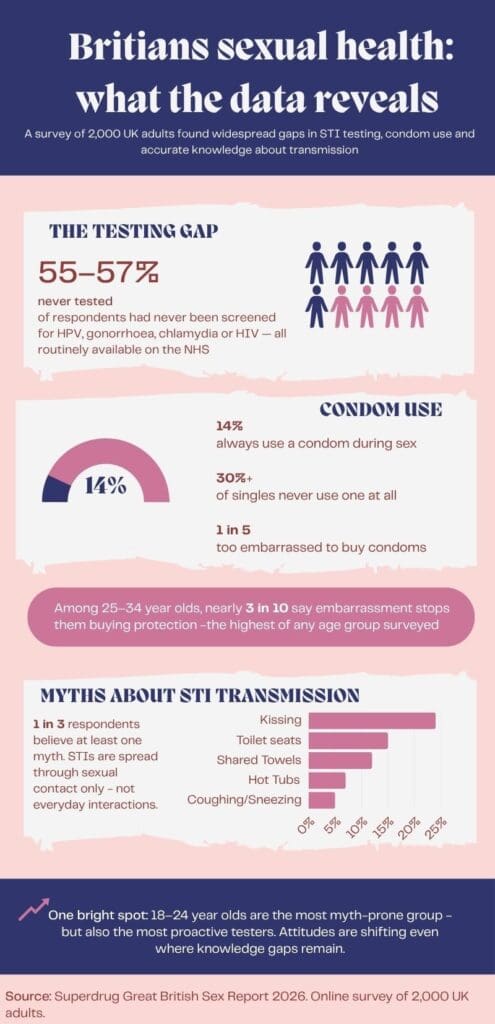
Condom use is low – and embarrassment is part of the reason
Only 14% of respondents said they always use a condom during sex, while more than 30% of single people said they never use one. Condoms remain the only contraceptive method that protects against both pregnancy and STIs, yet one in five people surveyed said they felt too embarrassed to buy them – a figure that rises to nearly three in ten among 25 to 34-year-olds.
“Condoms are often stigmatised or dismissed due to myths – such as claims they are too small, uncomfortable, or ruin the mood – despite the wide range of options available,” said Hajer Adshwir, former education and wellbeing specialist at Brook.
“Free condom distribution remains a key NHS health promotion tool, but its effectiveness depends on proper education.”
Misinformation is widespread – but highest amongst those most likely to test
One in three respondents believed at least one myth about STI transmission. The most common misconceptions were that infections can be caught through kissing (24%), toilet seats (15%), shared towels (12%), hot tubs (7%), and coughing or sneezing (5%).
Young adults aged 18 to 24 were the most likely group to hold these misconceptions – yet they were also the most proactive about getting tested.
The gap between curiosity and accurate knowledge points to the limits of information access without structured education.
“Misinformation spreads quickly, particularly online, and is harder to correct than to prevent. This makes early, accurate and accessible education critical,” Hajer said.
Stigma shapes both behaviour and access
Beyond knowledge gaps, stigma remains a structural barrier in sexual health.
“Stigma and the fear of being recognised prevents some people from accessing local sexual health clinics.
“Concerns about confidentiality, community visibility, and being ‘outed’ in terms of sexual health status, activity or identity are very real,” Hajer said.
She also notes that cuts to sexual health services have compounded the problem.
“Sexual health professionals have long warned that cuts to services and education reduce people’s ability to understand and manage their sexual health, especially when changes happen without community consultation or education on their potential impacts to their own and communities’ present and future health outcomes.”
In the report, Dr Ashrafi urged the solution to these gaps must start with normalisation.
“Improving sexual health means normalising testing, tackling myths, and making protection feel routine rather than awkward.”
If you would like more information or support around sexual health, the following free services are available:
The NHS offers free STI testing and contraception advice across the UK. You can find your nearest sexual health clinic at nhs.uk/service-search, or access free home testing kits for chlamydia, gonorrhoea, HIV and syphilis through NHS-commissioned service SH:24 at sh24.org.uk.
For those in London, free online testing is also available through Sexual Health London at shl.uk.
Source: Superdrug Great British Sex Report 2026, online survey of 2,000 UK adults.