
There’s a joke that we often like to make to one another, especially after another uninspiring relationship has run its course. It goes something like: what if I just became a nun? No dating apps, no situationships, no performing desirability for someone who doesn’t care. Instead, opting for a small quiet room, a sense of purpose, maybe a dramatic outfit, maybe God, maybe not. The Nunnery Plan. It’s a joke, mostly, but also kinda not.
The nun has long been a figure of cinematic obsession precisely because she represents a specific male anxiety: a woman who has structurally removed herself from the economy of male desire. Nunsploitation, the horror subgenre built around combining the sacred and the sexual, constantly frames celibacy as unnatural, drawing on the psychological toll of repressed sexuality within authoritarian environments.
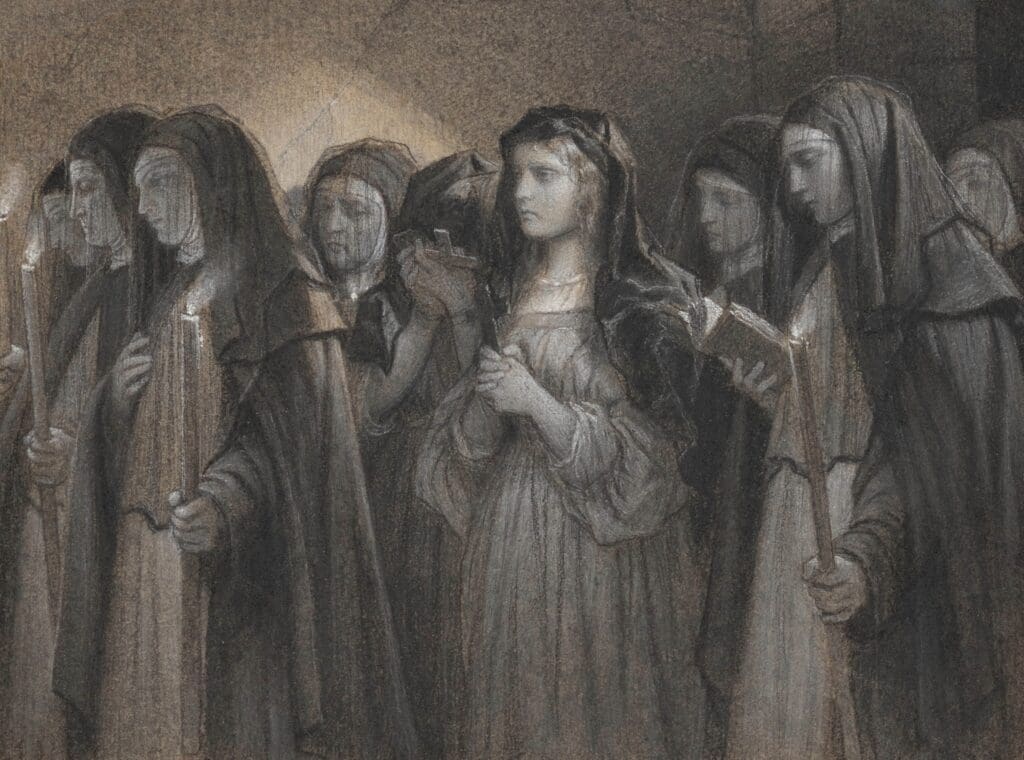
However, women are increasingly arriving at their own version of the nunnery plan, and they don’t look repressed, they look relieved.
The 4B movement originated in South Korea in the mid-2010s as a direct response to endemic misogyny and a culture in which women’s domestic and reproductive labour was structurally expected and systematically undervalued. The four B’s: bihon (no marriage), bichulsan (no childbirth), biyeonae (no dating), bisekseu (no sex with men), represented a wholesale withdrawal from heterosexual relationship structures as a form of political resistance.
Following the 2024 US election results, search interest in 4B spiked 450% in America, with over 200,000 people searching the term. This details a growing number of women arriving at an underlying interest in a life organised around their own interior.
Since then, this loose idea of the nunnery plan has evolved, and its newest iteration is less manifesto, more liberation.
The phrase ‘decentering men’ is credited to writer and social media creator Sherese (Charlie) Taylor, who coined it in her 2019 book of the same name. Since then it has exploded across TikTok and beyond, and it carries a fundamentally different energy to 4B. Where 4B was defined by its prohibitions, decentering men is defined by what you gain.
Meg, a political lesbian (someone who rejects heterosexuality as a choice) in her twenties, describes what decentering men means to her: “It means putting all my emotional energy into women, both platonic and romantic, and making that the focus of my relationships and experiences.”
Decentering men doesn’t just require abstinence from men, it calls for a recentering of the self.
“For me it means a lot more than just ‘choosing not to date men’. It’s about where you put your energy. And when you stop directing it toward men, you suddenly have so much more of it.”
The nunsploitation genre deceivingly encourages the idea that the woman who opts out is suffering, waiting to be unlocked. But the women arriving at their own nunnery plans, whether it be the 4B movement, or decentering men suggest otherwise.
“When the male gaze is completely eliminated, so is a whole package of complications around self-worth. I feel a whole lot more confident.”
For a generation of women, the nunnery plan has evolved from punchline to philosophy, and crucially, it’s one that’s becoming increasingly easier to adopt.