
This article contains discussion of sexual coercion and emotional abuse within intimate relationships. Reader discretion advised.
Sophia curls the sleeves of her hoodie over her hands as she talks. Now in her twenties, she speaks about intimacy with a calmness she says she never had before. Every so often, she laughs softly, usually after admitting something that once felt impossible to say out loud.
A year ago, she says, even small moments of affection used to make her anxious. Now, the biggest difference is how safe she feels inside her own body.
“For a long time, I genuinely thought something was wrong with me,” she says. “Now I realise I was constantly anxious because I never fully felt safe.”
Sophia, who is using a pseudonym for privacy reasons, began a relationship during the COVID-19 pandemic that quickly became central to her life. They were young, inseparable, and deeply attached. From the outside, everything appeared healthy.
“Overall, we looked like a definition of a perfect relationship,” she says. “But behind the scenes, it was very toxic and abusive.”
Looking back now, she can trace the pattern back to the very beginning.
“For me, it didn’t even start in the bedroom,” she says.
At first, the pressure felt small enough to dismiss. They rarely saw each other in person; her boyfriend constantly pushed for intimate pictures.
“I would do it to make him feel happy and satisfied,” she says, “but he would pressure me to send more, even though I would say no because I wanted it to come from the heart.”
Even their casual meet-ups began to carry an expectation she had not agreed to.
“If we went for a walk in a park and we were suddenly in an area where no other people were around, he would stop and try to initiate a make-out session,” she says. “Eventually I had to tell him: ‘I don’t want to go into parks with you because every time we go somewhere private, you try and make out with me.’”
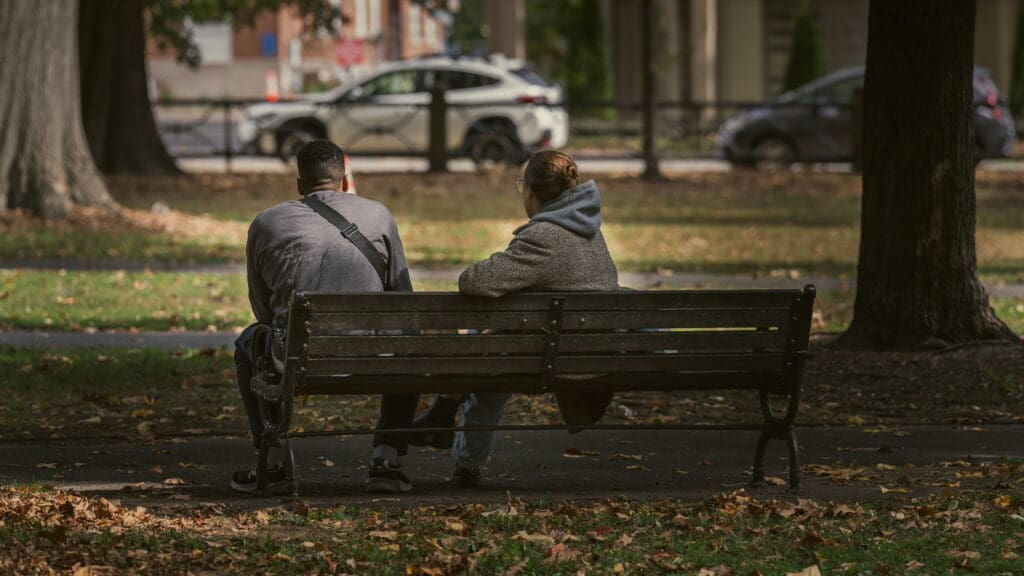
A couple sits together on a park bench. Image: Martin Podsiad / Unsplash
At the time, Sophia thought she was simply overthinking it. Both of them were each other’s first serious relationship.
“I didn’t really know what’s normal,” she says. “Especially because we were both inexperienced.”
When they started seeing each other almost every day, the pressure became harder to ignore.
“Every time we would see each other, he would try to initiate sex with me,” she says.
If she said no, he pushed her further.
“He’d say, ‘Why don’t we try a different position?’ or ‘We don’t have to have sex, why don’t you just give me head instead?’”
Over time, Sophia found herself constantly monitoring her own behaviour around him.
“I had to explicitly explain to him my body language signals,” she says. “I was saying no to him two, five, eight times, and he would still find ways to proceed.”
Sometimes, she says, he became irritated when she rejected him, which slowly made her feel responsible for his frustration.
“It made me feel like this was somehow my fault,” she says. “Like he’d been patient with me, so I owed it to him to try again.”
One of the biggest warning signs, she reflects, was that intimacy stopped feeling emotionally safe.
“I felt like I couldn’t be intimate with him even in a small way,” she says. “Things like making out made me anxious because I felt like he would take that as a signal for something bigger.”
Besides the physical intimacy, she describes him as loving, supportive, and emotionally attentive.
“Our sex life and our relationship life were two very different things,” she says.
“To me, being a good girlfriend was loving him and supporting him, but the second sex was involved, being a good girlfriend suddenly felt like compromising my own sexual experience to satisfy his.
“The further he pushed things, the more he just felt like this scary figure that was hungry for one thing, and it was my body.”
There were still ordinary days, inside jokes, affection, and the familiar comfort of someone who had been in her life for years. That made the harmful moments easier to shrink in her own mind.
“The fact that I loved him very much was always bigger than the fear,” she says.
“Sometimes I would gaslight myself that we were just having a nice, intimate moment rather than something I clearly did not enjoy.
“I think I mistook being happy that it was over for thinking it was a pleasurable experience.”
She also became hyperaware during sex itself.
“I was definitely hyper aware of every single thing,” she says. “Most of the time, I just hoped that this would be over soon.”
At first, Sophia struggled to understand just how deeply the relationship had affected her. Healing appeared through ordinary things she barely noticed at first.
“I didn’t realise how tense I was all the time until I wasn’t anymore,” she says.
Recovery, she explains, was about relearning comfort, sleeping properly again, and feeling relaxed. She no longer prepared herself for somebody else’s disappointment every time she said no.
During the relationship, Sophia often blamed her body for not responding the way she thought it should.
“I thought my lack of pleasure was my own fault and I blamed my body for it,” she says. “But later I understood that it was my body’s response to not being comfortable around him. My body was reacting exactly how it should’ve reacted.”
That realisation changed the way she understood intimacy entirely.
“I stopped associating intimacy with pressure,” she says. “That was probably one of the biggest changes.”
Over time, she also became more comfortable setting boundaries without immediately feeling guilty afterwards.
“I used to apologise for everything,” she says, laughing softly. “Even saying no felt like I was doing something mean.
“Healing for me was mostly learning to trust myself again and realising that discomfort is there for a reason.”
One of the biggest parts of that process was speaking openly after years of silence.
“Opening up is one of the biggest things that helps,” she says. “When you’re isolated, you start convincing yourself everything is normal.
“Just remember that there’s always a support network around you that you can rely on, and you’re not alone, because this happens to a lot of other people too.”
She now encourages people in similar situations to stop dismissing recurring anxiety, guilt, or emotional discomfort as ordinary parts of intimacy.
“One thing I would say is, it’s really easy to say, ‘just leave that situation,’ but it’s easier said than done,” she says. “So don’t feel ashamed if you’ve recognised you might be in a situation like this, but you can’t get yourself to leave.”
For Sophia, healing also meant allowing herself to trust people again, even when that initially felt frightening.
“It’s difficult to trust somebody new,” she says. “But it’s also a lot worse to trust the past in who you’re with now.”
For a long time, Sophia did not think of the relationship as coercive. Like many women, she associated sexual violence with strangers rather than long-term partners.
“I just want people to know that this definitely does happen in relationships,” she says. “And it’s not just a thing that happens on a one-night stand.”
According to the World Health Organization, around one in three women worldwide will experience physical or sexual violence during their lifetime, most commonly from an intimate partner. In England and Wales, around 40% of women who experienced rape or assault by penetration said the perpetrator was a current or former partner.
Leaving, she says now, was the hardest part.
“Probably by far the hardest thing I’ve ever had to do in my life,” she says. “It also made me upset because I knew that I had to get out of that situation despite having loads of feelings for that person.”
Still, she says the relationship ultimately changed her understanding of herself in ways she now considers important.
Today, intimacy no longer feels connected to obligation, guilt, or emotional pressure. She trusts her instincts faster. She no longer apologises for boundaries she believes are reasonable.
“If someone actually loves you, they’re not going to just keep doing that,” she says.
Then she smiles slightly.
“The whole perspective that I have in sexual intimacy now is completely different from how I was when I was with him,” she says. “Honestly, I feel much stronger and happier than I did before.”