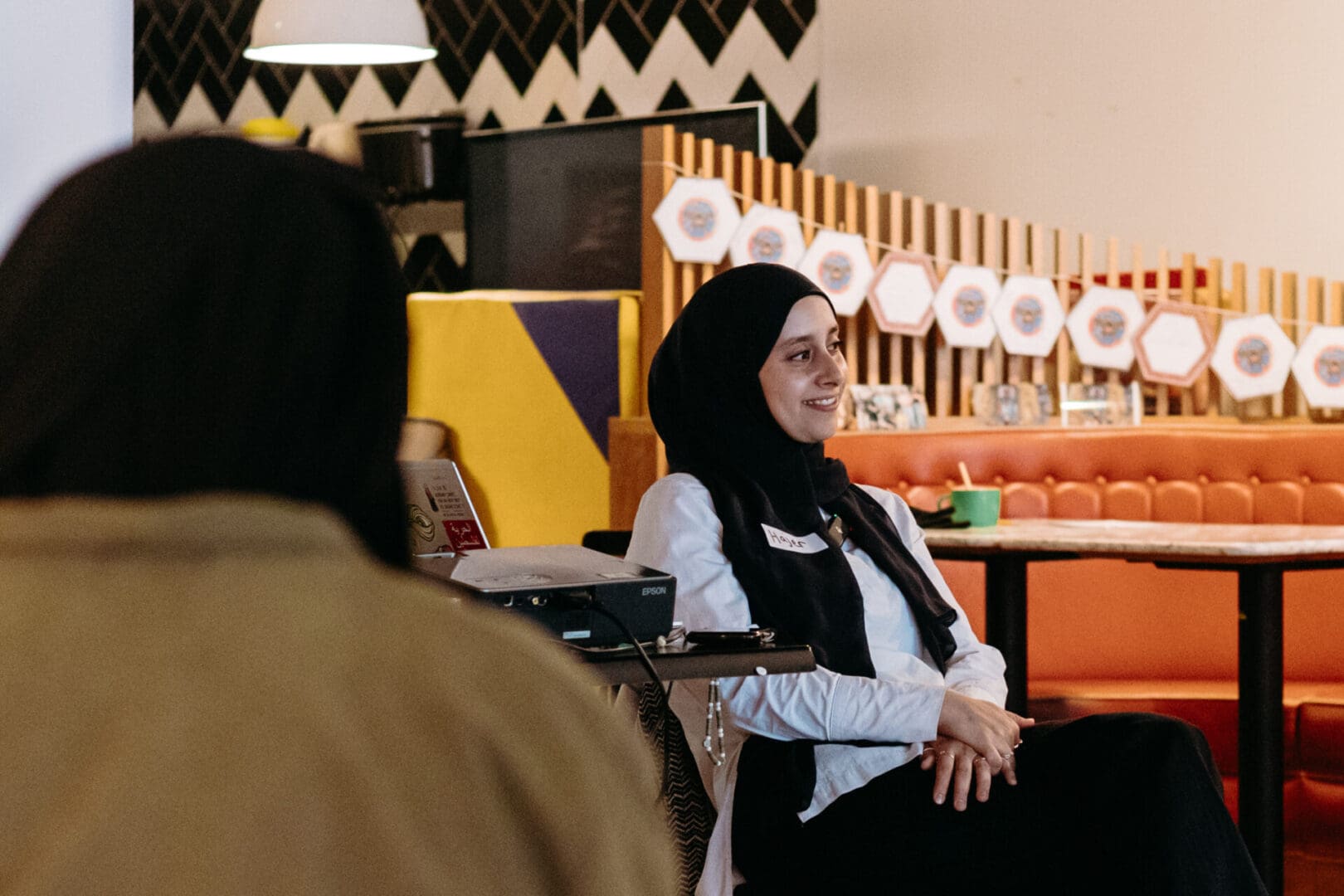
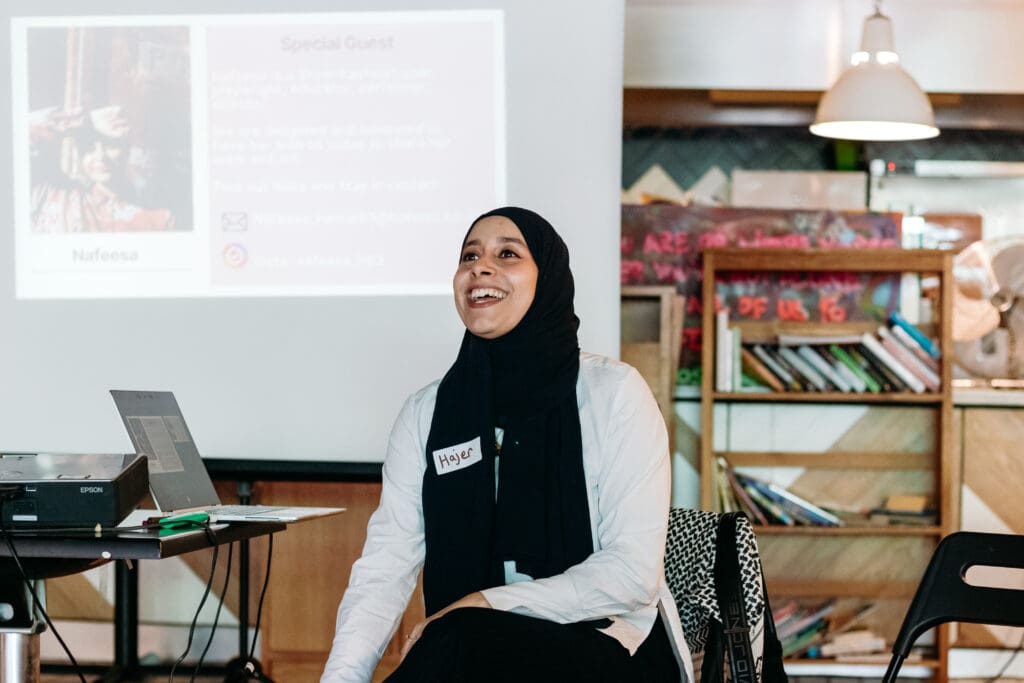
Hajer Adrwish doesn’t lower her voice when talking about sex. She doesn’t rush or sugar-coat her language to make it easier to swallow. Instead, she explains sexual health with calm certainty – measured, thoughtful, and occasionally punctuated by a giggle that suggests she’s answered these questions many times before. ‘
In a field where a woman in a hijab is still treated as unexpected, Hajer is simply bored of the assumption. Islam and sexual health being incompatible is a misunderstanding she refuses to entertain anymore.
“I have always seen Islam and sexual health as complementary. So many Islamic principles are based on it, you can’t separate the two.”
Growing up as a Muslim girl in the UK, Hajer always sensed that something was missing from the sexual health education she received: “I just didn’t have the language for it yet.”
Shaped by cultural shame, colonial influence and patchy education, Hajer now works as Programme Coordinator at Split Banana, creating accessible relationships and sex education for schools, colleges and community organisations.
Her journey into this work was not planned. Hajer studied a degree in Public Health where a module on Violence and Health led her to research forced marriage. “That was the first time I wrote from passion and really talked about health.” Realising she cared deeply about consent, bodily autonomy, and sexual health especially in South Asian communities, Hajer set out to find out what this spark meant.
While volunteering in primary schools, delivering healthy eating workshops, Hajer realised that she wanted to be an educator – just not about food.
“I like talking, facilitating, and being in a space where you’re supporting people’s learning,” she explained.
“But the topic was too boring for me. I knew I needed to do more.”
Her next inspiration came from Brooke, a sexual health charity that visited her predominantly Muslim college. Seeing them engage meaningfully with students who shared her background made her question why she hadn’t seen herself in that role before.
“If they can do that in a college where they know their demographic, then I need to go and find out what they’re all about,” she said.
Hajer’s own sexual education was fragmented. Her parents tried their best to share knowledge in what they understood as an “Islamic way,” but much of what was framed as religious turned out to be cultural. And her school failed to fill the gaps.
“Everything was centred around celibacy and purity culture. And if you asked questions, you were labelled a feminist and that was it.”
Her Islamic education was also unexpectedly shaped by Catholic ideology. She recalls a lesson on abortion that later turned out to involve anti-abortion propaganda from a Catholic organisation.
“It really shows how colonial ideas have bled into other religious institutions.” Gender identity was also touched on but narrowly, with lessons centred on being a wife, a mother, or a daughter.
“As a teenager, you’re trying to build your own identity as a girl or a woman, and you’re constantly being pushed into boxes you don’t fit into and don’t even want to fit into,” she said.
Being the eldest sibling and granddaughter, Hajer often felt alone in navigating these key moments around sexual health.
“I didn’t really have anyone to turn to. I had to learn for myself.”
After university, Hajer spent four months in Zambia with Restless Development, delivering sexual health education in schools – an experience that would become a turning point.
“The thing that really struck me was the contradiction,” she explains.
“Young people were told not to have sex before marriage, yet STIs were widespread. Condoms were recognised as the most effective form of protection – but we weren’t allowed to talk about them in schools.”
Working within the strict boundaries of the Ministry of Education, with limited access to electricity or internet, Hajer found herself navigating religion, culture, and policy all at once.
“It was challenging – you’re trying to create and deliver meaningful education in a short space of time, while being told what you can’t say.”
When she returned to the UK, she expected the sexual health landscape to be easier to navigate.
“Little did I know how difficult the sexual health space was, even in the so-called sexualized Western world,” she said.
On the surface, nothing seems taboo anymore. But Hajer disagrees.
“Sex is mostly treated as a joke. People still shy away from serious conversations about mental and physical health within sex.”
She points to the way Western culture simultaneously hypersexualises men while policing women’s bodies, an attitude that carries real consequences.
“You can’t tell people not to sexualise women while hypersexualising men and then ignore how that impacts mental health.”
And within her work, it’s clear where these approaches have materialised. STI rates remain high in the UK, yet they are still being treated with humility.
“No one jokes about having a cold. It’s just something that can happen to everyone. There is no shame in Islam or in education,” she said.
For Hajer, these attitudes are not accidental. She traces them back to how Victorian-era values were exported around the world.
“I used to be sceptical that Victorian ideas could still shape us – but they’ve seeped into the fabric of so many cultures. We’re only now beginning to confront the lasting physical and psychological trauma left behind.”
Acknowledging this history can be uncomfortable, particularly within Muslim communities.
“We’re taught that Islam is protected by Allah (God) and can’t be corrupted. So, when you suggest our understanding and teaching may have been tainted by colonial ideas,’ people get defensive.”
It took Hajer time to accept this herself.
“We know from history that humans repeat patterns. I looked a lot at Victorian sexual hyper-sexualisation and that framing isn’t Islamic, but it’s a language Muslims still use today.
“Not talking about things or genders not mixing aren’t Islamic concepts. Islam teaches respect and colonialism has reframed that into silence and control.”
Changing this, she stresses, requires a generational shift.
“It’s very hard to undo hundreds of years of messaging. If you haven’t unpacked that yourself, you can’t unpack it for a community.”
The problem with silence around sexual health isn’t just about sex itself, it’s about everything that follows. Pregnancy is discussed, marriage is expected and children are assumed. But experiences that disrupt that narrative are often excluded. For Hajer, miscarriage is one.
“It’s still taboo and brushed under the carpet. And yes, it’s part of sexual health, mental health and the life cycle.”
Periods are another example.
“Periods affect half the population, yet they’re still taboo. Islamically, they’re central to faith but culturally and socially, access to basic hygiene and period products is still a struggle. We shouldn’t be battling this much.” I
n many Muslim communities, these moments become identity markers. Womanhood is often framed through marriage and motherhood, narrowing the space for other experiences.
“We obsess over these topics, yet we don’t talk about having good experiences – first sex, relationships, communication. People assume sexual health means divorce or cheating. It doesn’t, it means navigating relationships well.”
In sexual health education, the messenger matters too. Hajer has witnessed how representation shifts the atmosphere when people recognise themselves in the educator.
“Seeing a visibly Muslim person, or someone who shares their identity, talking about these topics is very important. Especially for boys – they need to see men who reflect them.”
Hajer recalls a particular moment in her career that has stayed with her since – after delivering a session at a majority-Muslim school a young girl approached her, notebook in hand.
“I’ll never forget her face, ” she said, ‘I’ve been waiting for this. I’m so happy you’re here.’ “At the time, I was questioning whether I wanted to continue this work. But moments like that remind me why I do it,” she expressed with gratitude.
This positive impact hasn’t come without obstacles. Early on, Hajer faced doubts from her community, with attention fixed on her marital status rather than expertise.
“People would ask, ‘Are you married?’”, “You don’t go to a cardiologist and ask, ‘Have you had open-heart surgery?’ So why is sexual health treated differently?”
As one of the few hijabi women in the sector, Hajer feels the weight of visibility daily.
“Whether you like it or not, you’re representing your faith and right now is the hardest time to be Muslim. But part of being Muslim is how you carry yourself, how you speak, and how you represent a faith you love.”
At the heart of Hajer’s work is a desire to make sexual health conversations accessible, and grounded in care, especially for Muslim women who are often left navigating these issues alone.
“I want people to live happy, well-rounded lives where they can speak openly, navigate harm when it happens, and access the support I didn’t have. Sexual health is lifelong and shapes our experiences at home, school, work, and across generations. We need better conversations to move forward together.”